Tuesday, 6 December 2011
Monday, 5 December 2011
John Alexander Game-Shooting/Pheasant Shooting Photography
A recent game-shoot in Buckinghamshire in lovely but freezing weather
To view my Game-shooting packages see my website:
www.jeaphotography.co.uk
To view my Game-shooting packages see my website:
www.jeaphotography.co.uk
Wednesday, 23 November 2011
My turn - Textures
After seeing my guests at my recent workshops photographing textures and getting some great images doing it (link), I felt the urge to take some of my own.
Today I saw faces everywhere - I promise I didn't go looking for faces. That would be a little sad. Look! I even saw Elmo on a water tanker. Its getting weird. My friend Anna and I laughed as soon as I pointed it out.

Donald Duck?
Today I saw faces everywhere - I promise I didn't go looking for faces. That would be a little sad. Look! I even saw Elmo on a water tanker. Its getting weird. My friend Anna and I laughed as soon as I pointed it out.

Donald Duck?
Monday, 21 November 2011
John Alexander Photography - Workshops
Having just finished 3 weekends of workshops from the Jurassic Coast of Dorset to the hustle and bustle of London to the traditional farm of Oxfordshire I feel so excited to add new dates next February!
It was so much fun and I believe everyone had a great time learning the fundamentals of photography in some beautiful locations. Click here to see some behind-the-scenes photographs.
I was staggered by how quickly everyone picked it up and produced some amazing photographs - Have a look here at some guests favourite photographs of the day and some kind words about their experience.
If you would like to improve your photography, I have just put some new dates up for February next year. The aim of the course is to make you see with "photographers eyes" in a very relaxed atmosphere in some great locations around the UK.
Click on the link and find out which location you would like and what date suits you best!
http://www.johnalexander.me.uk/workshops.html
Thanks and looking forward to hearing from you
John
www.johnalexander.me.uk
info@johnalexander.me.uk
07828135696
Thursday, 17 November 2011
Passers-by - London
When scouting out for my London Workshops which take place in February next year, I noticed this homeless man right in the middle of the path. This view of St. Pauls is not a unique one. I often see photographers with their tripods in this position. However, this homeless man with his dog transformed the scene from a landscape photograph into a portrait. I initially attempted to use a long shutter-speed of 30 seconds but noticed it was completely completely blur! Apparently Millennium Bridge is constantly moving plus the passing footsteps jolted my tripod as they walked passed. So I opted for a slower shutter-speed to keep everything sharper. I also knew that these relatively slower shutter-speeds would blur the commuters as they move past me. I had to take a few shots as the man and his dog moved in some exposures. Eventually the shot came together when the man and his dog remained stationary momentarily and the sudden influx of commuters brought more drama to the image. Can you have a portrait photographs and not show their face? I think you can!
Tuesday, 8 November 2011
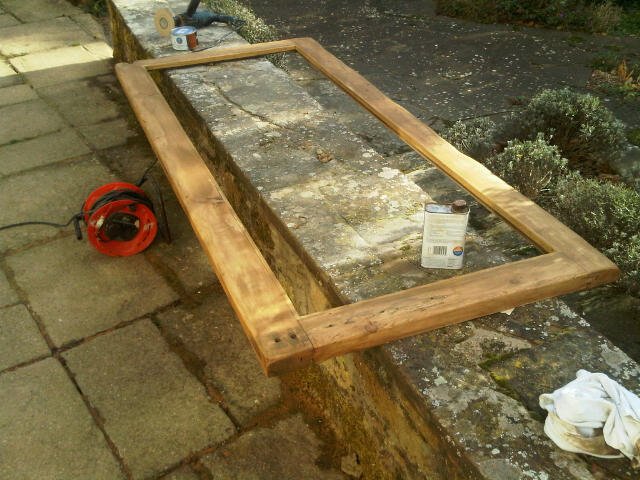
Custom-made Frames, The history and the making behind the creation.
Its hinges ripped off from its now naked, weathered frame. They took them purely for their scrap value. The hinges were sitting motionless, when I found them, crammed in a cob-web infested, cardboard box stowed away from eyes view with similar others who had met the same fate.


When dragged out onto the floor into the light, it was only too easy to see the harsh reality of the world we live in. The clanging of iron against iron resonated around the room as I sieved through the corroded box of metal, some bits flaking off in my hand.
I finally found the pair of rusty hinges which matched the door I had picked out from the others, like a scene from CSI. The old bolt hung loosely from the hinges, which once connected the two together giving its door-like qualities. I re-kindled the hinges back to their original door-frame for the first time since they were torn apart from each other nearly 20 years ago.
I left with the old door and its hinges bouncing around in the back of my car ready for their transformation.
I "scooped" out the middle with hammers and saws to leave just the outside frame
Wax with a matt finish to give it back its old, gnarled looks again.

Hinges placed back on the door-frame to give it back its character and to show its history.

Some poor photography with my camera phone
Finished off with non-reflective glass, white mount and Nun's Cross Farm print.
Overall size is 2 metres.
NEXT!
Thursday, 20 October 2011
Olde Tractor & Why Cameras are Rubbish!
While scouting out possible locations for my future Oxfordshire workshops I came accross this old farm. I knocked on the door and asked permission from the owner to photograph some of the barns - Rex, the owner, slightly bemused, gave me the nod.
This is finally the shot I was looking for. I have been back and forth to this same position 6 times in the last 3 days.
This 1974 Ford tractor sits in the old hay barn waiting for its turn to shine again - Rex told me that the cylinders are shot, and the exhaust system is broken as well. It used to get let out once a year to cart the hay out to the lambs for winter bedding in the barns on the hill. Now it stays in situ for 11 months of the year. It reminded me of Brum.
I walked around the barn, thinking of how I would compose the picture. Eventually I pulled the tripod legs out and found this spot - I looked down as one of the tripod's legs wasn't sitting on the ground properly. I looked down in the dark corner and discovered that I had put my tripod leg entirely through the semi-rotted body of a rat the size of a beaver. I let out a subtle yet masculine-ish yelp and hit my head on the wooden beams above me.
After removing the corpse, I realised why this scene was so difficult to photograph.
Why Cameras are rubbish!
CONTRAST
Very simply, the contrast is the range of brightness in the scene. A high contrast, as in this photograph, shows there are very bright parts of the image (entrance of the barn on the left) and very dark parts of the image (the roof or parts of the beams).
When looking through our eyes, we can see the detail in the brightest part of the image AND in the darkest shadow but the camera cannot. Without getting too technical - our eyes have a higher dynamic range than the camera - Our eyes are able to pick up a larger range of brightness than cameras can.
Here is an example:
Here is the finished shot of Moreton Forest in Dorset. You can see that it is a high contrast scene. This is how I saw it with my eyes.
This is how the camera sees it.
This is the first image I took - See how the foreground is well exposed but the trees at the top are completely white and overexposed. This is because cameras can not see the amount of brightness as our eyes can.
This is the second shot I took - I made the shutter-speed faster to let less light, giving a darker image than the previous.
You can see now that the foreground is under-exposed but the trees are well exposed.
This scene had a too high contrast for the camera to deal with... so what do I do?
GRADUATED FILTERs
For any landscape photographer, in fact, any photographer, these are a must. Graduated filters reduce the range of brightness (dynamic range) of the image. By placing them over the brightest part of the photograph (usually the sky) the camera is now able to cope with the amount of brightness of the scene.
I placed this filter over the trees until half way down the image and the camera produced this photograph.
Piece of cake!
John
Subscribe to:
Posts (Atom)